Live
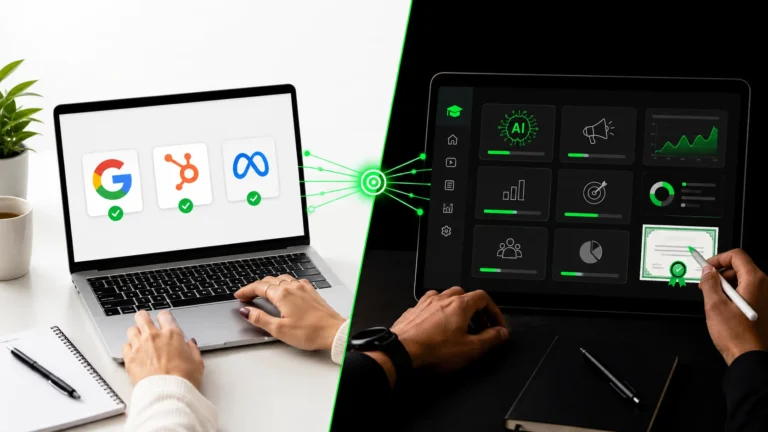
The AI-Powered MonSoon Internship Cohorts are LIVE 



You can learn the Fundamentals of Digital Marketing Free Course by following a focused roadmap: understand audiences and funnels first, then practice content, SEO, social media, email, paid ads, and analytics on one small project. Free courses are useful, but practical output is what turns basic learning into job-ready confidence.
A Fundamentals of Digital Marketing Free Course is most useful when it gives beginners a clear learning sequence, not just a list of videos. The right roadmap helps you understand customer needs, content, search, social media, email, analytics, and basic AI-assisted workflows before you invest in advanced training.
The internet has no shortage of “free digital marketing course” lists.
The problem is that most lists leave beginners with 17 tabs open, three half-finished certificates, and no idea what to do next.
That is why this guide takes a different route.
Instead of telling you to collect courses, it gives you a realistic learning sequence. You will know what to learn first, what to practise, what free resources to use, and how to create proof of skill without spending money.
“Digital marketing is not one skill. It is a connected system: message, audience, channel, measurement, and improvement.”
For college students, freshers, career switchers, and curious learners, that distinction matters. A certificate may help your profile. A small portfolio of real work helps someone understand what you can actually do.
Quick Summary
- Learn the marketing foundation before touching advanced tools.
- Practise using one imaginary or local business as your case study.
- Build basic skills in content, SEO, social media, email, ads, and analytics.
- Use free official learning resources before buying a course.
- Turn weekly exercises into a visible portfolio.
- Choose guided projects only after you understand what you need help with.
| Learning phase | Main outcome | Suggested time | Proof to create |
|---|---|---|---|
| Foundation | Understand audience and funnel | Days 1–5 | One-page customer profile |
| Content and social | Create useful messages | Days 6–12 | Content calendar and posts |
| SEO and website | Learn discoverability | Days 13–19 | Keyword sheet and optimized page |
| Analytics and ads | Learn measurement basics | Days 20–25 | Simple campaign report |
| Portfolio | Package your work | Days 26–30 | Case-study presentation |
This roadmap is not a shortcut to instant employment. It is a structured way to move from “I watched a course” to “Here is what I planned, created, measured, and improved.”
What Are Digital Marketing Fundamentals?
Digital marketing fundamentals are the basic principles and channels used to reach, help, and convert audiences online.
They include audience research, positioning, content, search engines, social media, email, advertising, landing pages, and performance measurement.
A beginner does not need to master every area immediately. The goal is to understand how the parts connect.
For example, an Instagram post may create awareness. A blog post may answer a search query. An email may bring someone back. Analytics tells you what happened after they arrived.
HubSpot’s free Digital Marketing Certification includes 10 lessons, 30 videos, eight quizzes, and coverage of SEO, social media, email, reporting, lead generation, and more. It is a solid orientation resource, not a replacement for practice. HubSpot’s free Digital Marketing Certification course is a useful place to understand the complete channel mix.
What Should Beginners Learn First?
Start with three questions:
1)What action should they take next?
2)Who is the audience?
3)What problem are they trying to solve?
These questions stop digital marketing from becoming random posting.
Let’s say your practice project is a budget-friendly tiffin service near a college campus. Your audience may be students living away from home. Their problem is affordable, familiar meals. The next action might be a WhatsApp enquiry, website form, or trial order.
Everything you create should connect back to that context.
“Tools do not create strategy. They make a clear strategy easier to execute and measure.”
Why Do Free Courses Feel Incomplete?
Free courses often feel incomplete because they teach concepts in isolation.
You might learn SEO in one lesson, social media in another, and analytics in a third. But entry-level work requires you to connect them.
A content writer needs to understand search intent. A social media intern needs to recognise audience behaviour. A performance marketing trainee needs to interpret the action after a click.
This is not a criticism of free learning. It is a reminder to use free learning actively.
Google’s SEO Starter Guide makes this point in a practical way: SEO helps search engines understand content and helps users decide whether to visit a site. It stresses useful, unique, people-first content, descriptive titles, useful links, and clear page structure. Google’s SEO Starter Guide.
What Is the Biggest Beginner Mistake?
The biggest mistake is moving from one certificate to another without applying anything.
A better approach is to choose a small practice brand and improve it every week. It can be a fictional café, local tuition centre, college club, creator page, or small family business.
That gives every lesson a destination.
| Instead of this | Try this |
|---|---|
| Watching 10 SEO tutorials | Research 10 keyword ideas for one business |
| Saving social-media templates | Create a 7-day content plan with a clear goal |
| Memorising marketing terms | Explain the funnel for your practice brand |
| Collecting certificates | Build a one-page case study from your work |
| Learning every AI tool | Use one tool to improve one task responsibly |
The next step is to turn concepts into a learning plan you can actually finish.
How Can You Learn Digital Marketing Free?
Use a 30-day beginner roadmap that combines learning with small deliverables. Expect to spend about 60–90 minutes most days.
How To Start Today
Time Needed: 30 days, 01 Hours, 15 Minutes daily
Estimated Cost: USD 0
Description: Build a foundation in digital marketing through free lessons, small weekly assignments, and one portfolio-ready practice project. The aim is clarity and output, not collecting every certificate available.
Tools Name: Google Docs, Canva Free, Google Trends, Google Analytics Skillshop
Materials Name: One practice business, a spreadsheet, a notebook, a free email account
1)Choose one practice business or project
Pick a business with a clear audience and simple offer. Avoid switching topics each day because consistency makes your learning measurable.
2)Write a one-page audience and offer brief
Describe the customer, their problem, your offer, major alternatives, and one primary action you want them to take.
3)Learn one channel, then create one asset
Study content marketing, SEO, social media, email, ads, or analytics. Immediately create a related asset for your chosen practice project.
4)Track what you created each week
Save links, screenshots, drafts, assumptions, and learnings in one folder. This becomes the raw material for your portfolio.
5)Review and improve one asset weekly
Ask: Is this useful? Does it match the audience? Is the call-to-action clear? What would I test next?
What Should You Learn in Week One?
Week one is about the customer, not the platform.
Learn basic positioning, the marketing funnel, audience research, and simple messaging. Then write a customer profile and a basic brand statement for your practice project.
A useful format is:
Audience:
Problem:
Desired outcome:
Our offer:
Why choose us:
Primary next action:
This is simple, but it prevents the common beginner habit of creating content without an audience or purpose.
How Do Content and Social Skills Connect?

Content marketing is the process of creating useful material that earns attention and moves people toward a next step.
Social media marketing is one way to distribute that material, build familiarity, and start conversations.
During week two, choose one platform that fits your practice audience. Do not attempt every platform at once.
For a student-facing service, Instagram or LinkedIn may make sense. For a local business, Google Business Profile content and Instagram may be more relevant. For B2B services, LinkedIn and email could be more useful.
Create these five items:
- One educational carousel or post.
- One short-form video script.
- One customer question-and-answer post.
- One offer-focused post.
- One seven-day content calendar.
The value here is not whether the post “goes viral.” It is whether you can explain the objective, audience, message, format, and next action.
How Do You Learn SEO Without Paying?
Start with search intent, keywords, page structure, and measurement.
SEO means search engine optimization. It is the practice of improving a website so search engines can understand its content and users can find relevant answers.
Google explains that there is no secret that automatically ranks a page first. Improvements can take weeks or longer to show results, so SEO is an iterative skill rather than a one-time trick. Google’s guidance on SEO improvements and timelines.
For week three, do these four tasks:
- Use Google search suggestions to list 15 questions people may ask.
- Check Google Trends to compare interest and seasonality.
- Choose one realistic keyword and identify the likely search intent.
- Draft a page outline with a helpful title, clear headings, and relevant internal links.
Google Search Console becomes useful once you work on a live website. It can show queries, clicks, impressions, indexing information, and page performance. You do not need it to practise the concepts, but you should learn what it measures.
What Is Search Intent?
Search intent is the reason behind a search query.
A person searching “what is SEO” wants an explanation. Someone searching “best SEO agency in Delhi” is comparing options. Someone searching “Google Ads course fee” may be closer to a decision.
| Search intent | Example query | Best beginner content format |
|---|---|---|
| Informational | What is digital marketing? | Explainer article or video |
| Navigational | HubSpot Academy course | Direct resource page |
| Commercial research | Best free marketing courses | Comparison guide |
| Transactional | Enrol in marketing program | Program landing page |
Understanding intent is more valuable than forcing a keyword into every sentence.
Why Should Beginners Learn Analytics Early?
Analytics teaches you whether your marketing work did something useful.
Without measurement, you can spend time on posts, pages, and campaigns without knowing whether they attracted the right people or encouraged meaningful action.
Google’s Analytics Academy on Skillshop provides free e-learning courses and currently lists four training courses plus a certification. It covers property setup, data collection, reporting, and ways to assess online marketing effectiveness. Google Analytics Academy on Skillshop.
For beginners, learn these terms first:
- Users: People who visit or interact.
- Sessions: Visits or periods of activity.
- Traffic source: Where visitors came from.
- Engagement: Whether visitors meaningfully interacted.
- Conversion: The action you wanted, such as a sign-up or enquiry.
You do not need to become a data analyst in week one. You need to become comfortable asking, “What changed, why might it have changed, and what should we test next?”

Can AI Help Beginners Learn Faster?
AI can help beginners brainstorm, organise research, improve first drafts, create variations, and analyse simple data patterns.
It should not replace judgement.
For example, you can use AI to suggest ten content angles. You still need to decide which angle is useful for your audience. You can use AI to draft a social caption. You still need to check the facts, tone, clarity, and brand fit.
HubSpot includes an “AI as a Strategic Advantage in Digital Marketing” lesson in its current free certification curriculum, reflecting how AI is becoming part of modern marketing workflows. HubSpot’s digital marketing curriculum.
Use AI responsibly through this sequence:
- Start with your own audience brief.
- Ask AI for options, not final truth.
- Verify claims using original or authoritative sources.
- Edit for accuracy, personality, and relevance.
- Keep a record of what you changed and why.
That final step is important. It builds your decision-making skill, which is far more valuable than generating quick output.
How Do You Build a Beginner Portfolio?
A beginner portfolio should show your thinking, not pretend you managed a major brand.
Create two or three small case studies from your practice project. Each one can be one to three pages long.
Use this structure:
| Portfolio section | What to include |
|---|---|
| Context | What the business or project does |
| Audience | Who you were trying to reach |
| Goal | Awareness, enquiries, traffic, or sign-ups |
| Work created | Posts, keyword sheet, email, audit, or landing-page outline |
| Reasoning | Why you chose that message or channel |
| Measurement plan | What you would track |
| Learning | What you would improve next |
This is especially useful for internship interviews. Recruiters cannot expect a fresher to have years of results. They can expect clear thinking, curiosity, communication, and evidence of consistent practice.
If you are preparing for your first opportunity, read this guide on a digital marketing internship for freshers. It can help you understand what employers may look for beyond certificates.
When Should You Choose Guided Learning?
Choose guided learning after you have explored the basics and know the difference between passive watching and active practice.
A good structured program should give you clear briefs, deadlines, feedback, real-world tasks, portfolio support, and a sensible introduction to modern AI-enabled workflows. It should not promise unrealistic outcomes or make vague placement claims.
Before paying for any program, compare what you will actually practise, who provides feedback, and what work you can show at the end. This guide on choosing a paid digital marketing internship program in India offers a helpful checklist for evaluating options.
For learners ready to move past self-paced study, VELYON AI INSTITUTE can be explored as a structured, project-based next step. Start with the fundamentals first. Then select guided learning because it gives you a stronger practice environment—not because it makes unrealistic promises.
What Free Resources Should You Use?
If you are comparing options, treat a Fundamentals of Digital Marketing Free Course as your starting layer. Use free, authoritative learning resources to understand the essentials before paying for specialised tools, mentorship, or project-based programs.
Use a small, reliable resource stack rather than chasing every new platform.
- HubSpot Digital Marketing Certification
Free, structured introduction covering core channels; currently listed as 3 hours and 24 minutes with 10 lessons. - Google SEO Starter Guide
Official introduction to helpful content, crawling, titles, links, images, and search visibility. - Google Analytics Academy
Free Skillshop learning for GA4 setup, reporting, and marketing measurement. - Google Skillshop
Free, self-paced training and certifications for Google products, including Google Ads.
Transparency note: This article is educational. External resources are recommended because they are useful to beginners. VELYON AI INSTITUTE is mentioned as a possible guided-learning option; readers should independently compare curriculum, support, pricing, and suitability before enrolling.
Frequently Asked Questions
Can I learn digital marketing for free in 2026?
Yes. You can learn the fundamentals through free courses, official product documentation, practice projects, and publicly available tools. The key is applying each lesson to a real or simulated project.
What is the best fundamentals of digital marketing free course?
There is no single best option for everyone. HubSpot’s free Digital Marketing Certification is a well-structured starting point because it covers SEO, content, social, email, reporting, and strategy.
How long does it take to learn digital marketing basics?
A focused beginner can understand the basics in around 30 days. Developing confidence requires continued practice, feedback, and real project work over several months.
Should I learn SEO or social media first?
Learn audience research and content basics first. Then explore SEO and social media together, because both depend on understanding audience needs and useful messaging.
Do free digital marketing certificates help get a job?
They can support a resume, especially for beginners. However, employers often value practical work samples, clear communication, and the ability to explain your decisions.
Do I need coding to learn digital marketing?
No. Basic digital marketing roles do not require coding. Understanding simple website concepts, analytics, and tracking can help, but you can begin without technical programming skills.
What Are the Key Takeaways?
- A free course is a starting point, not a complete career plan.
- One consistent practice project teaches more than scattered tutorials.
- Audience, message, channel, and measurement are the core marketing system.
- AI can speed up work, but human judgement creates useful marketing.
- A simple portfolio makes your learning visible to recruiters and clients.
- Choose paid or guided programs for feedback and project practice, not hype.
What Should You Do Next?
Start this week with one practice project.
Create an audience brief, study one lesson, and publish or draft one asset. Repeat that cycle for 30 days. At the end, package your work into a short case study.
If you want to understand entry-level expectations, use the VELYON resources on digital marketing internships for freshers and how to evaluate paid internship programs.
The aim is not to become an expert overnight.
It is to become someone who can learn a problem, create a practical response, measure it, and improve it. That is the foundation of a useful digital marketing career.
Conclusion
The best way to learn the Fundamentals of Digital Marketing Free Course material is not to treat learning as a race for certificates. Use free resources to build your foundation, then practise every concept through one focused project.
Start with the basics. Keep your work visible. Ask better questions every week.
When you are ready for feedback, accountability, and project-based structure, explore the next learning step that genuinely fits your goals. VELYON AI INSTITUTE is one option to consider after you have built that initial foundation.